Rosa Nice
Musician
Not So Nice? Think Again.
Rosa Nice: Singer, Songwriter, and CEO of Not So Nice Records & Promotions
It was 1 a.m. when Rosa Nice boarded a flight out of New Orleans with her 10-month-old in her arms. Just 22, she’d worked up the courage to leave an abusive relationship and walk away from her car, her clothes, and the apartment she’d worked so hard to own.
She was coming home. To Philadelphia.
Today, ten years later, Rosa Nice is a singer, songwriter, social advocate, and the CEO of Not So Nice Records & Promotions, one of the only women-owned record labels and music promotion companies in Pennsylvania. She’s a Grammy voting member, a public health graduate, and a Philly-rooted artist with 14 original songs to her name, all produced in the city that gave her a second chance.
“Philadelphia never looked at me like I was a problem,” she says. “The city looked at me like somebody who had potential.”
Rosa was born to a military family in Jacksonville, North Carolina. When her parents divorced, her mother followed an academic path to the Philadelphia suburbs, eventually landing a position at Valley Forge Military Academy and College, where faculty housing came with the job. From 5th grade through high school, Rosa was a Radnor kid.
It wasn’t easy. She was overweight, and vividly remembers boys teasing her as she walked past them in the hallways. The girls she sat with at youth group would ignore her in the school cafeteria.
She was a good student, though, and won a full ride to Loyola University New Orleans. But coming from a sheltered life on a military campus, she wasn’t prepared for life at one of the world’s great party cities.
And New Orleans had other ideas. All-Star Weekend, the Beyoncé Super Bowl, and Mardi Gras all landed within the first three weeks of her second semester on campus. For a kid who’d grown up with almost no freedom to make her own choices, it was overwhelming. She dropped out. Got married. And soon found herself in an abusive relationship with an infant and no degree.
“I had extremely low self-esteem,” she says. “When I went to college, I got lost because I didn’t know who I was.”
A Second Chance
Back in the Philadelphia suburbs with her mother, Rosa was ready. Really ready. And Philadelphia responded.
Rosa connected with Women Against Abuse and the City of Dreams Coalition, and threw herself into volunteer work, political campaigns, and community organizing. She knocked on doors for Sharif Street, Malcolm Kenyatta, and Cherelle Parker. She enrolled at Community College of Philadelphia, where her mother was now working, and qualified for a program that lets non-dependent students attend tuition-free. Then a grant for survivors of domestic violence helped her get into her first apartment in the city.
She graduated from CCP in 2019 with an associate’s in psychology, and then earned a bachelor’s degree from Wilmington University. She just earned her Master of Public Health degree at Tulane University, concentrating in community health sciences, with a focus on trauma-informed anti-racism training for healthcare providers.
In 2018, scrolling through social media, Rosa spotted a video from a local Philly rapper who was looking for a personal assistant. It was an interesting chance, and she jumped at it.
She helped plan parties, lock down brand partnerships, organize music video shoots, and help models with wardrobe. She loved it. Then one day, the rapper walked her into a recording studio called HDE and introduced her to the owner: a producer who went by Pop Trax.
She didn’t know it at the time, but Rosa had walked into Philadelphia music royalty. Pop Tracks is Leon Huff Jr., son of Leon Huff, co-founder of Philadelphia International Records and the architect of the Philadelphia Sound. His father and uncle, Kenny Gamble, helped create the soundtrack of an era. On her first day in that studio, Gilly the Kid was there. So were his sons.
“At the time, I had no idea who all these people were,” she says.
Pop Tracks became her mentor, and has since produced seven of her fourteen songs. He was also the one who told her to post pictures when she put her music online, to start building out a personal platform.
Rosa now has around 100,000 followers across her social media channels, up from 600 when she started. She’s worked as a production assistant for Made in America for its final two years and for the Navy 250. She records at HDE and at Milk Boy, the storied studio on 7th and Callowhill where Miley Cyrus has also cut tracks.
Her sound is pop with an R&B soul, shaped by the Aretha Franklin and Louis Armstrong records she grew up on, and the hip hop beats she learned to love in Philly’s studios. She calls it “Pop’N’B.”
The music world has noticed. In 2022, Rosa was accepted into GrammyU, the Recording Academy’s program for student musicians, and earlier this year she became a full voting member. She attended her first Grammys ceremony in January, seven days in Los Angeles, making connections and getting, as she puts it, “initiated as an up-and-coming star.”
“Music is where my confidence comes from,” she says. “Admitting that I had a voice and that I should use it is how I started to build self-esteem in a way I never had before. Music helped me stop being silent.”
The City That Made Her
Philly’s music scene, Rosa will tell you, is small. That’s the point.
“When you’re running with the right group of people here, you’re going to meet Diana Williams, you’re going to meet Adam Blackstone,” she says. “You’re going to run into Philly royalty just because you’re in that world.”
Williams is a radio legend who broke nearly every major R&B artist to come out of Philly, including Pink. Blackstone has written and produced for nearly everyone. In a city this size, if you show up, you get in the room. Open mics run every night of the week. Rec Philly, a membership-based production space, puts professional studio equipment within reach of anyone willing to walk through the door. The City of Dreams Coalition, on whose board Rosa served, launched a recording space specifically for youth.
“Music is the soul and heart of Philly,” she says. “On any given day, at any given time, you can find somebody performing — mainstream or local, it doesn’t matter. That’s what’s really cool.”
Rosa now lives in Bethlehem, in the Lehigh Valley, about an hour and a half north. The pandemic took her there; she followed her mother, who’d become a dean at Lehigh University.
But she considers herself a loyal Philadelphian. Her record label is registered here, and she happily pays her city wage tax. Most of her bookings, recordings, and volunteer work happen here.
“Philly is home,” she says. “It will always have my heart.”
Philly, she says, welcomed her with open arms when she had nothing and has kept welcoming her since. In return, she teaches survivors about available resources, advocates for musicians’ rights on Capitol Hill through the Recording Academy, and uses her platform and her public health training to address racial health disparities.
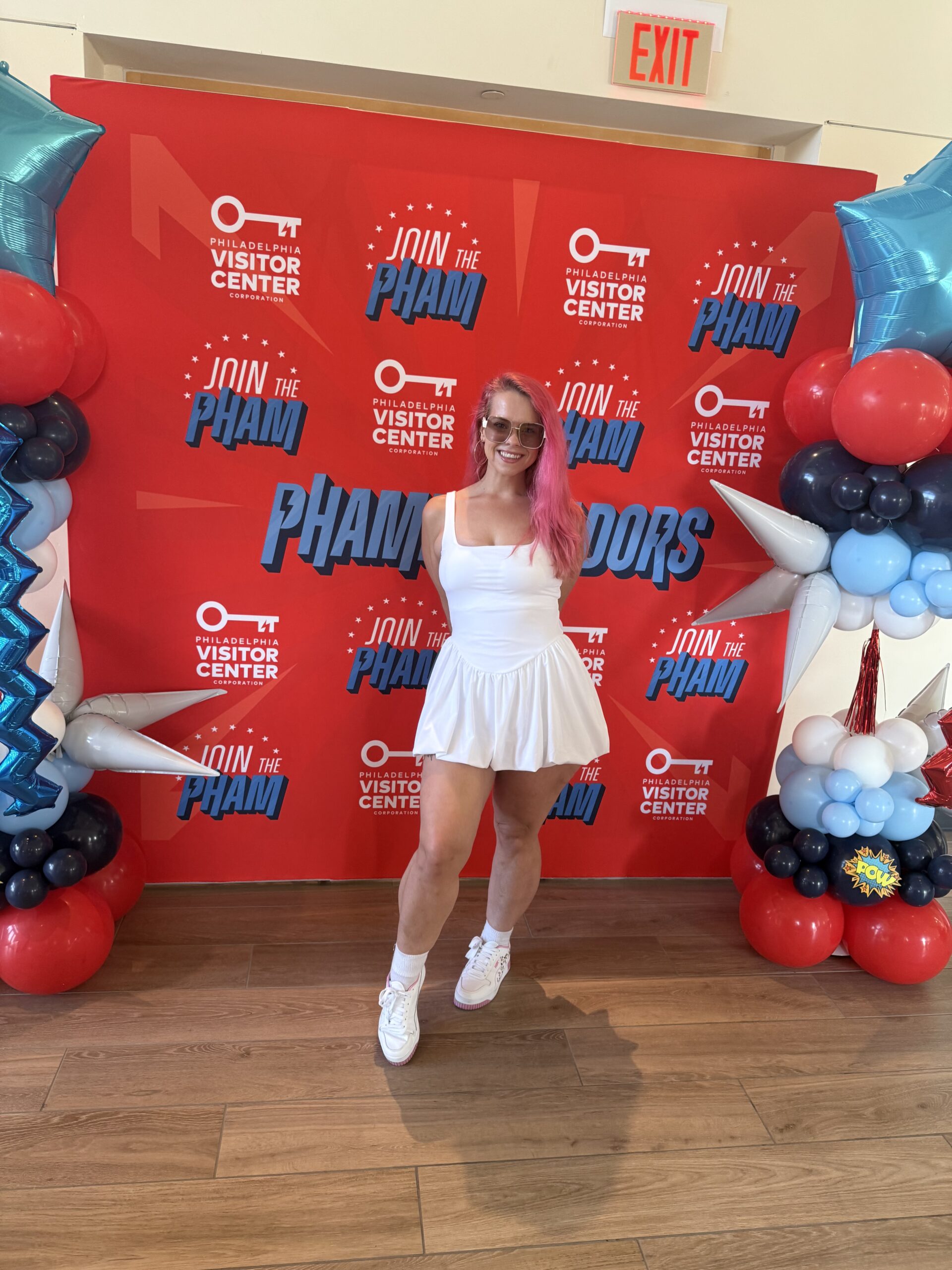
It’s why, when she was invited to join Phambassador, Philadelphia’s program for passionate city advocates, she didn’t hesitate.
“Being a Phambassador gives me a chance to give back to a city that has given me so much,” she says. “You should have seen how happy people were at the airport when we were there. That’s what it’s all about.”
She came here at 1 a.m. with a baby in her arms and nothing else. Philadelphia saw something in her anyway.
The rest, she built herself. Right here.